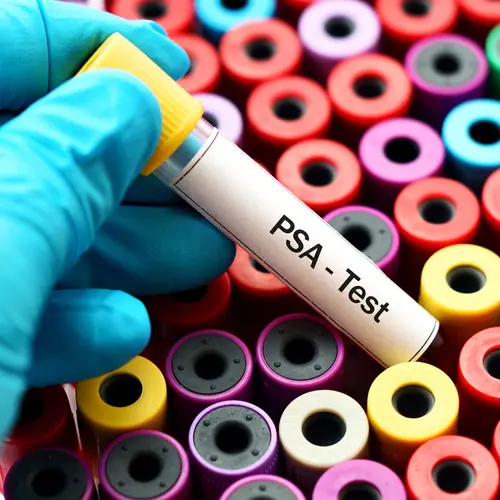
What Is Prostate-Specific Antigen?
Your prostate is a gland that makes seminal fluid, which nourishes and transports your sperm when you ejaculate. It's about the size of a walnut and surrounds your urethra (the tube that you pee out of) just underneath your bladder.
Cells in your prostate make a protein called prostate-specific antigen (PSA). A PSA blood test measures the amount of PSA you have circulating in your blood. The amount of PSA your cells make tends to go up as you get older, but it can also be high in people with:
- Prostate cancer
- Prostatitis, an infection or inflammation of your prostate
- An enlarged prostate, or benign prostatic hyperplasia (BPH), a common, noncancerous condition that typically develops after age 50
Why is the PSA test done?
Doctors generally use a PSA test to help figure out what is causing prostate problems. But it’s also used to screen for prostate cancer. Prostate cancer is the second most common cancer (after skin cancer) in the U.S. in people who are assigned male at birth (AMAB).
If you have a prostate, you have about a 12% chance of getting prostate cancer at some point in your life, although each person's risk varies depending on their age, race or ethnicity, and other factors. But deciding to get cancer screening isn't always an easy decision, especially if (as with prostate cancer) many more people get it than die from it. For instance, the American Cancer Society estimates that in 2024, about 299,000 people in the U.S. will be diagnosed with prostate cancer and 35,000 people will die from it. About 3.3 million people who have been diagnosed with prostate cancer are still alive today.
If you are over 50 and have a prostate, talk to your doctor about getting a PSA test. They can help you decide what your risk factors are and if testing makes sense in your situation.
When Should I Have My PSA Levels Tested?
The first thing to do is to talk to your doctor about the pros and cons of prostate cancer screening before you decide whether to be tested. Don’t get tested until you have that talk. Opinions differ about when you should do that.
The American Cancer Society says to get tested at age:
- 40 or 45 if you’re at high risk
- 50 if you’re at average risk
The American Urological Association suggestions on the basis of age:
- Under 40: No screening
- 40 to 54: No screening if you’re at average risk. If you’re at a high risk, you and your doctor can decide.
- 55 to 69: Screening if your doctor suggests
- Over 70 or less than a 10-15 year life expectancy: No screening
The U.S. Preventive Services Task Force says:
- Men aged 55 to 69 who have prostate cancer risks may need testing.
If your doctor thinks you might have prostate cancer based on either a PSA level or a rectal exam, a biopsy is the next step. This is a test where the doctor takes a small amount of tissue from your prostate and sends it to a lab for tests. It’s the only way to find out if you have prostate cancer.
What Are Normal PSA Levels?
There’s no single PSA level that’s considered normal. In the past, experts considered a PSA of below 4 nanograms per milliliter normal, and many labs may still use this as a cutoff when deciding who to recommend for further testing.
Several factors may cause your PSA levels to vary, such as:
- Your age
- Your general health condition
- Your personal and family medical history
- The size of your prostate (for instance, BPH is an enlargement of the prostate gland that happens in many people as they get older, and it can also raise your PSA level)
- If you have an infection or inflammation (for instance, prostatitis can raise your PSA level)
- Ejaculation or vigorous exercise in the 2 days before your test (tends to raise your PSA level)
- Having a prostate biopsy or cystoscopy (tends to raise your PSA level)
- Treatments for BPH, such as finasteride (Proscar) and dutasteride (Avodart) (tend to lower your PSA level)
- Some other medicines (such as aspirin, cholesterol-lowering drugs, and water pills) and herbs may lower your PSA levels and your doctor will need to account for this when they interpret your test results
However, in general, the higher your PSA, the greater your chances of having prostate cancer.
What are normal PSA levels by age?
There's no one PSA level that's considered normal. In general, PSA levels are higher in older people than in younger people, even in those who don't have prostate cancer or other prostate conditions.
Most doctors and medical organizations don't use age-specific PSA ranges because there's no agreement about how useful they are.
PSA Test Preparation
Certain medications, medical procedures, and health conditions can affect your PSA test results. Before you take the test, make sure your doctor knows if you:
- Take drugs for BPH, such as finasteride (Proscar) and dutasteride (Avodart).
- Take finasteride (Propecia) for hair loss.
- Have had surgery for BPH, such as a transurethral resection.
- Had a prostate biopsy within the past 6 weeks.
- Had a procedure affecting your urinary system, such as a urinary catheter.
- Have any health conditions that affect your liver, such as cystic fibrosis, hepatitis C, or liver cirrhosis.
- Have an ongoing urinary tract infection or you’ve had one in the past 3 months.
What not to do before a PSA test?
A couple of activities can also affect your PSA test result. Avoid the following n the 48 hours before your test:
- Ejaculation. This may raise your PSA level, so no sex or masturbation.
- Vigorous exercise. This may also raise your PSA level, so it’s best to skip working out and, especially, riding a bike.
PSA test cost
Most states have laws that require insurance plans to cover annual screening for people aged 50 and over and for those at higher risk for prostate cancer. The following groups are at higher risk:
- People older than 50.
- African Americans and those of Afro-Caribbean ancestry.
- People with a family history of prostate cancer, such as those with a parent, child, or sibling who were diagnosed with it. Or some people with family members who were diagnosed with breast, ovarian, or pancreatic cancer.
Medicare covers annual PSA tests for those with Medicare who are 50 or over. If your doctor does not accept Medicare, you may pay an office fee but not for the test itself. Medicaid coverage varies by state, but most cover screening.
PSA Test Procedure
During a PSA test, you will have blood drawn from a vein in your arm. You may feel a little discomfort when the needle goes in and comes out, and you may have bruising or bleeding after the test. The process should take less than 5 minutes. Once your blood sample is collected, it will be sent to a lab for analysis. Typically, you’ll get your results within a week.
What Is a Dangerous PSA Level?
No PSA level is dangerous. However, a PSA over 10 nanograms per milliliter is linked to a 50% chance of prostate cancer. And the higher your PSA climbs above this level, the greater your chances of having prostate cancer. But again, a high PSA test result doesn't necessarily mean you have cancer. Your PSA level climbs with age, and it may be high for health reasons other than prostate cancer, including:
- An enlarged prostate or BPH
- An infection in your prostate (prostatitis)
- A urinary tract infection or irritation
- Being born with a larger-than-normal prostate
A PSA in the range of 4-10 nanograms per milliliter is linked to a 25% chance of prostate cancer. Most people with a PSA below 4 nanograms per milliliter don't have prostate cancer, but there's no guarantee. Sometimes, even people with a low PSA level have prostate cancer.
What does a high PSA level mean?
If your test shows you have a high PSA, that doesn't necessarily mean you have cancer. Your doctor will likely have you take another PSA test to make sure your level is higher than normal. Your doctor can also order other tests to help figure out why your PSA levels are high, such as:
- Different PSA blood tests, such as a percent-free PSA, Prostate Health Index, 4Kscore test, or IsoPSA
- Lab tests, such as ExoDx Prostate (IntelliScore) or SelectMDx
- A digital rectal exam where your doctor will use a gloved finger to feel for any bumps or hard areas in your prostate
- Imaging tests such as a transrectal ultrasound (which uses soundwaves to make images of your prostate) or an MRI scan
- Prostate biopsy, in which tissue samples are taken from your prostate and checked in a lab for signs of cancer
Factors That Might Affect PSA Levels
A number of factors, such as medications, medical conditions, even your everyday activities, can raise or lower your PSA level, at least temporarily.
Factors that can lower your PSA include:
- The BPH medication dutasteride (Avodart)
- The BPH and hair loss medication finasteride (Propecia or Proscar)
Factors that can raise your PSA level include:
- Prostatitis (inflammation of your prostate)
- Enlarged prostate, or BPH
- Prostate cancer
- Being born with a larger-than-normal prostate gland
- Recent prostate biopsy
- Recent surgery for BPH or other urinary issues
- Health conditions that affect your liver, like liver cirrhosis, cystic fibrosis, and hepatitis C
- Urinary tract infections or irritation
- Older age
- Ejaculation
- Vigorous exercise, especially bike riding
At Home PSA Test
Some companies now sell PSA test kits that let you collect a blood sample at home and send it to a lab for testing. There is one advantage to taking an at-home test, including it's convenience. You don't have to make a doctor's appointment or arrange for travel or time off of work. This may allow you to get a test when you otherwise wouldn't have done it.
However, before deciding to take the test, you need to talk to your doctor so they can explain the benefits and cautions. Also, you will need help from your doctor interpreting your results. The test alone can' tell you if you have prostate cancer. Your doctor considers many different pieces of information when they interpret your results.
Alternative PSA Testing
When your doctor initially tests your prostate-specific antigen (PSA), they look at the total amount of PSA in your blood. If this test shows you have a high PSA level, your doctor may have you take some additional tests to decide if you need a prostate biopsy.
Additional tests include:
Percent-free PSA. PSA comes in two major forms. One form, called complexed PSA, is attached to proteins in your blood. The other form, called percent-free PSA, circulates freely in your bloodstream. This test measures how much of your total PSA is freely circulating. The percent-free PSA tends to be lower in people with prostate cancer.
Many doctors will recommend a prostate biopsy if you have a percent-free PSA of 10% or less. They will suggest a prostate biopsy if you have a percent-free PSA of 10%-25%.
PSA velocity. This isn't a separate test, but it looks at the results of more than one total PSA test to see if your PSA level is rising and if so, how fast.
Complexed PSA. This measures the amount of PSA that is attached to proteins in your blood. It’s not widely used, but it may be done rather than assessing total and percent-free PSA levels.
Combination tests. Newly developed tests combine the measurements that you get from different PSA tests. If your total PSA is 4-10 nanograms per milliliter, your doctor may use the results of these tests to help them decide if you need a biopsy, or another biopsy if you already had one. These tests include:
- Prostate Health Index, a test that combines total PSA, percent-free PSA, and another protein called proPSA.
- 4Kscore, a test that measures total PSA, percent-free PSA, intact PSA, and a protein called human kallikrein 2 (hK2). This test can help determine your risk of aggressive prostate cancer when considered along with your age, biopsy history, and results from digital rectal exams.
- IsoPSA test, a test that looks at different forms of PSA in your blood for signs they were made by cancer cells.
PSA density. If you have a larger prostate gland, it's likely that you'll have a higher PSA level. To adjust for the size of your prostate, your doctor will measure its volume with an ultrasound and then divide your PSA score by that volume. A higher PSA density shows that you have a greater chance of getting prostate cancer.
Urine tests. These tests look for two pieces of genetic material in your pee that are made in higher amounts by prostate cancer cells: prostate cancer antigen 3 (PCA3) mRNA and TMPRSS2-ERG gene fusion.
Problems With the PSA Test
There are both advantages and risks of having a PSA test for cancer screening. Talk to your doctor about these advantages and risks and what makes sense for your medical situation.
Some risks of having a PSA test include:
Some prostate cancers are slow-growing and they never spread beyond your prostate gland. Therefore, not all cases of prostate cancer are life-threatening and need treatment. Treatment for prostate cancer has risks and side effects, such as urinary incontinence, erectile dysfunction, and bowel dysfunction. And a cancer diagnosis can be stressful even if it has a low chance of spreading.
PSA testing isn't perfect. It's possible to have an elevated PSA level even if you don't have prostate cancer. For instance, benign prostate enlargement or prostate infection can cause elevated PSA levels, as well. And some kinds of prostate cancer don't make much PSA. So, it's possible to have prostate cancer even if you don't have an elevated PSA level.
PSA testing has lowered the number of deaths from prostate cancer. However, it's hard to say, on an individual level, whether the test's benefits outweigh the cost and risk of potential side effects.
Some advantages to having a PSA test include:
PSA testing for cancer screening may help detect prostate cancer early, when it's easier to treat and more likely to be curable.
Testing can be done with a simple and widely available blood test.
Some people prefer to know one way or the other if they have prostate cancer.
The number of deaths from prostate cancer has gone down since PSA testing became available. This is likely because testing allowed doctors to diagnose some people before their cancer became advanced.
Using the PSA Blood Test After Prostate Cancer Diagnosis
Your doctor can get helpful information from a PSA test even after a prostate cancer diagnosis. For instance, your doctor can use your PSA levels for:
Active surveillance. This is an option for people with prostate cancer who may not need treatment. Your doctor will monitor you closely to start treatment if your cancer starts to grow or spread. Generally, your doctor will test your PSA levels about every 6 months and do a digital rectal exam once a year. You may also get imaging and a prostate biopsy every 1-3 years.
After surgery for prostate cancer (prostatectomy). After your prostate has been removed, your PSA will generally drop within a couple of months to a very low or even undetectable level. If you still have PSA in your blood, your doctor may suggest a few more PSA tests to see if this level goes up over time and, if so, how fast it's rising. If your PSA rises fast after surgery, that may indicate that your cancer is still a concern and you need further treatment.
After radiation therapy for prostate cancer. Your PSA will likely drop to its lowest point slowly over about 2 years after radiation. Your doctor will test your PSA levels every couple of months. Again, if your PSA levels go up over several tests, especially if it's fast, you may need further treatment. Sometimes, PSA levels go up slightly in people who have had external beam radiation or brachytherapy. Usually, this doesn't have a long-term effect on you, and your levels go back down after a while.
During advanced prostate cancer treatment. People with advanced prostate cancer may have hormone therapy, immunotherapy, or chemotherapy instead of, or in addition to, other treatments. Your doctor can use your PSA level to see how well these advanced cancer treatments are working.
Takeaways
The PSA test can be used to help diagnose conditions like BPH, but it's most commonly used to screen for prostate cancer. There's no PSA level that is considered normal, but, in general, the higher your level is, the more likely it is that you have prostate cancer. Because so many factors affect your PSA level and your chance of getting prostate cancer, it's important for you to talk to your doctor before you have a PSA test, so they can help you make a decision about whether to get the test.
FAQs
How can I lower my PSA levels quickly?
There's no certain way to lower your PSA levels, especially quickly. Some lifestyle changes that may help you bring your PSA levels down over time include:
- Eat more foods with lycopene, which has anticancer properties. Foods with lycopene include tomatoes, watermelon, apricots, and grapefruit.
- Eat more plant-based foods. Vegetables and legumes may help make your immune system work better and prevent cancer cells from growing.
- Eat more foods with vitamin D, take a supplement or spend some time in the sun everyday. Vitamin D is found in fatty fish, vitamin-D fortified milk, plant-based milk, orange juice, cereal, or oatmeal.
- Get more exercise.